
COMBS Summer Scholar Program
We are inviting Australian and New Zealand undergraduate students in physics, engineering, astronomy, seismology or another relevant discipline who have finished second or third year to work in the labs of one of our Chief Investigators for a period of 6 – 12 weeks (payment AUD$750 per week).
There may be an opportunity to participate in the 2027 COMBS Annual Workshop in Victoria where you will meet other Centre members from around Australia and present your research project.
Applications close 11.59 pm Monday 24th August 2026.
COMBS is committed to achieving gender equity and strongly encourages applications from women and women identifying candidates.
Learn more below about:
- How to apply
- Applying for more than one project
- Summer Scholar Projects
How to apply
Applications must be submitted using the application form.
For general questions or information about specific projects, please email the contact supervisor as listed in the projects below.
Please prepare the following documents for upload into the application form:
- A cover letter indicating why you are interested in pursuing a Summer Scholar project with COMBS (1 page max);
- A copy of your academic transcript;
- A CV (2 pages max);
- Evidence of enrolment at an Australian or New Zealand university.
- A brief letter of reference addressed to the contact supervisor. Ideally, this letter comes from a lecturer who knows you or from someone who has supervised you in a previous research project.
Please ensure all uploaded files include your full name in the file name.
Applying for more than one project
If you are interested in multiple projects, you should submit an application for each project individually, with an individual cover letter for each project.
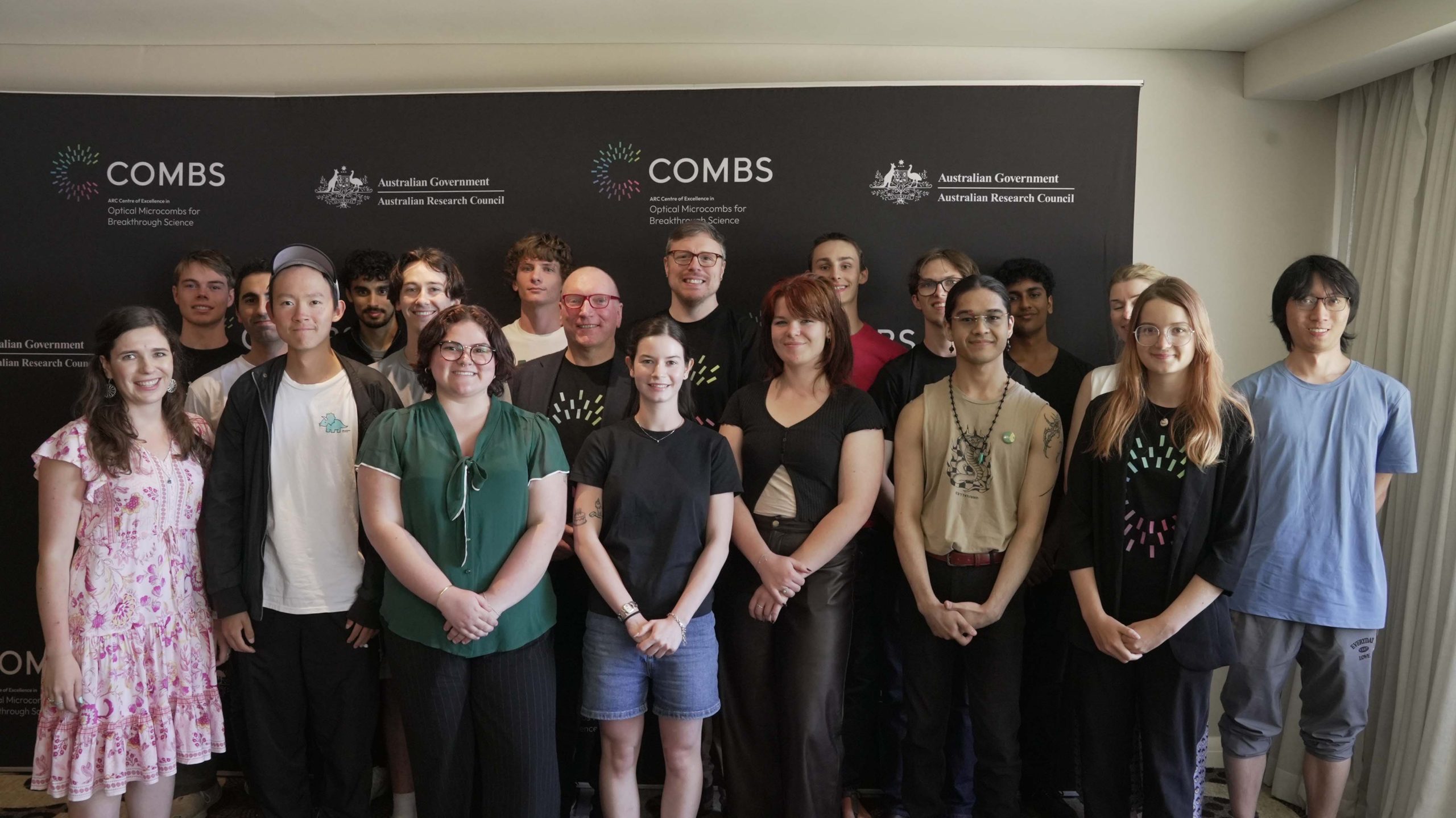
The 2025/2026 cohort of Summer interns at the 2026 COMBS Annual Workshop in Wollongong.
Summer Scholar Projects
Supervisor: A/prof. Bill Corcoran
Project Description:
Microcombs can support massively parallel communications channels, by putting a different set of data on each line in the comb. We can also investigate this in the time domain, where we link the separation between comb lines with the timing of the pulses they are built on, to generate and detect all optical superchannels. This can provide a way to make ultra-fast communications systems work, while reducing the burden on digital processing.
Tasks:
- This project will involve theoretical, numerical and experimental work, to help us start understanding the potential role that using the pulsed nature of microcombs could play in future communications systems. You will be looking into the practical trade-offs between bandwidth and capacity in this new type of system, both experimentally, and numerically, and help gauge where this new technology can provide benefits in fibre optic links.
Who Should Apply:
This project is aimed at 2nd year (and beyond) students studying physics, or engineering, particularly those who’d like to both work in the lab, and do some numerical modelling to understand theory.
Ideal for those who know a little about optics and/or photonics, and something about communications and signals, and want to get some idea of what working in a university research lab is like.
Eligibility: students must have completed two years of a STEM based undergraduate degree
For questions, contact the supervisor: A/Prof. Bill Corcoran – bill.corcoran@monash.edu
Supervisor: A/Prof. Andreas (Andy) Boes and Dr Van Thuy Hoang
Project Description:
Red Pitayas are FPGA development boards for test and measurement that are used in many academic labs (and industry) for implementing data acquisition, and in particular, high-performance feedback loops. In this project, existing codebase for a “digital PID lockbox” that precisely stabilizes the frequency of lasers will be developed and customized to the characteristic of photonic integrated circuit (PIC) lasers. This includes HDL and Python (GUI) programming, as well as closely collaborating with colleagues in the research lab to implement, optimize, and test the features relevant for the stabilization of lasers for optical atomic clocks. The final goal is to test the tailored digital PID solution by locking PIC to a spectroscopic reference.
Tasks:
- FPGA (HDL code) and Python programming
- Performing measurements with an optical setup
- Data analysis
Who should apply:
- Knowledge in FPGA (HDL code) and Python programming
- Experience with electronic measurements
- Motivated, independent, hands-on attitude
- Wanting to be part of a friendly and diverse research group
Eligibility: students must have completed two years of a STEM based undergraduate degree
For questions, contact the supervisor: A/Prof. Andreas (Andy) Boes – andy.boes@adelaide.edu.au
Supervisor: A/Prof. Bill Corcoran
Project Description:
Most applications of microcombs use the many wavelengths that they produce to support parallel data streams to get to aggregate rates of 10s of terabits per second. However, combs also have an inherent “tick”, which we can use for timing. Here, we’re looking at extracting that tick using a combination of analogue and programmable digital hardware (RFSoCs, incorporating FPGAs and analogue/digital interfaces), to synch massively parallel communications systems
Tasks:
- This project will work on FPGA coding on an AMD RF SoC, to create an “overlay” that can then be accessed for research purposes via python (or similar). This builds on an existing approach being developed in our lab for turning RF SoCs into flexible tools for COMBS science. Specifically, you’ll look at scaling an output from a microcomb to provide 10 MHz references for equipment.
Who Should Apply:
This project is aimed at 2nd year (and beyond) students studying engineering, particularly those who would like to get a feel for how some of the skills you learn in engineering fit into research.
Ideal for those who have programmed FPGAs before, and want to get some idea of what working in a university research lab is like.
Eligibility: students must have completed two years of a STEM based undergraduate degree.
For questions, contact the supervisor: A/Prof. Bill Corcoran – bill.corcoran@monash.edu
Supervisor: Prof. Sumeet Walia and Dr Taimur Ahmed
Project Description:
In this project, you will explore the intersection of advanced 2D materials and optical frequency combs (COMBS), focusing on developing a photodetector prototype that broadens the spectral response across the visible to infrared (IR) range. Optical COMBS are a series of equally spaced frequency lines, and their applications span from high-precision spectroscopy to advanced imaging techniques. Your work will centre on integrating low-dimensional materials such as Black Phosphorus (BP) and Indium Selenide (InSe) into a heterostructure to create a photodetector capable of detecting the broad spectral range necessary for COMBS applications. BP is selected for its tunable bandgap and strong absorption in the near-IR, which is critical for detecting lower-frequency comb lines. InSe, with its strong absorption in the visible range, complements BP, enabling the detection of higher-frequency comb lines. The heterostructure of these materials is expected to yield a device with enhanced sensitivity across the entire optical comb spectrum, making it ideal for applications in spectroscopy, telecommunications, and precision metrology.
By the end of this project, you will have developed a photodetector prototype capable of detecting a wide range of frequencies from an optical COMB, spanning from visible to IR wavelengths. This project will provide you with hands-on experience in the fabrication and characterization of 2D material heterostructures, as well as their integration into devices for cutting-edge optical applications. Your work will contribute to the development of more efficient and sensitive detectors for optical COMBS, with potential applications in spectroscopy, telecommunications, and beyond.
Tasks:
- Apply techniques such as mechanical exfoliation to prepare thin flakes of BP and InSe. Fabricate the BP/InSe heterostructures using dry transfer methods, ensuring precise alignment and clean interfaces.
- Perform photoluminescence (PL) and Raman spectroscopy to verify the quality of the heterostructures and their optical properties in the context of COMBS.
- Use absorption spectroscopy to measure the photodetector’s response across the visible to IR spectrum, ensuring it covers the broad range of frequencies generated by optical COMBS.
- Design and fabricate a photodetector prototype that integrates the BP/InSe heterostructure, tailored for detecting the specific frequency lines of optical COMBS.
- Analyze the photodetector’s performance in detecting different segments of the optical COMB spectrum, focusing on metrics such as responsivity, bandwidth, and signal-to-noise ratio.
Eligibility: students must have completed two years of a STEM based undergraduate degree.
For questions, contact the supervisor: Prof. Sumeet Walia – sumeet.walia@rmit.edu.au
Project 5: Hardware AI Accelerators on FPGA for Energy-Efficient Edge Intelligence - RMIT University
Supervisor: Prof. Sumeet Walia
Project Description:
This project focuses on the design and implementation of a hardware-based artificial intelligence (AI) accelerator using Field-Programmable Gate Arrays (FPGAs), targeting energy-efficient AI applications at the edge. With growing demand for real-time decision-making in autonomous systems, healthcare, robotics, and IoT, there is a critical need for lightweight and reconfigurable AI hardware that can operate under power and resource constraints.
In this project, you will explore how digital hardware, particularly FPGAs, can be used to implement core components of neural networks directly in logic. Unlike traditional CPU or GPU-based processing, FPGAs offer customizable data paths, parallelism, and low-latency execution that make them well-suited for deploying spiking neural networks (SNNs) and quantized convolutional neural networks (CNNs) on-device. You will start by designing a basic neural processing unit (NPU) architecture using hardware description languages such as Verilog or VHDL. Building on this, you will implement a simplified yet functional neural network model, such as a small CNN or a spike-based classifier, and deploy it on a low-cost FPGA board like the DE10-Nano or Xilinx Zynq.
The emphasis will be on optimizing the trade-offs between computational precision (e.g., fixed-point vs. floating-point arithmetic), logic resource usage, and inference speed, while ensuring the design remains scalable and adaptable to different AI workloads. Ultimately, this project aims to contribute to the field of neuromorphic and hardware-aware AI design, preparing you to address real-world challenges in edge AI systems.
By the end of this project, you will have successfully designed, implemented, and tested a custom AI accelerator on an FPGA platform, capable of performing neural network inference in real time. You will gain hands-on experience in digital hardware design, FPGA programming, and neural network architecture optimisation, skills that are in high demand across the AI hardware and embedded systems industries.
You will also develop critical insights into the trade-offs between power, performance, and precision in AI hardware, and understand the challenges of implementing machine learning algorithms in constrained environments. The final deliverables will include a functional FPGA-based AI accelerator, a comprehensive technical report detailing the design methodology, and a performance analysis that may serve as the basis for further research or prototyping.
Tasks:
Perform a literature review on existing hardware AI accelerators, including SNN and CNN implementations on FPGAs.
- Design a basic AI accelerator using Verilog/VHDL or high-level synthesis tools, targeting neural operations such as multiply-accumulate and activation functions.
- Simulate and validate the design using tools such as QuestaSim or ModelSim, followed by hardware synthesis using Quartus or Vivado.
- Deploy the design on an FPGA platform and test its performance using simple classification tasks.
- Evaluate performance metrics including power consumption, resource utilisation, latency, and accuracy, and explore potential for on-chip training or adaptation.
Eligibility: Students must have completed two years of a STEM based undergraduate degree.
For questions, contact the supervisor: Prof. Sumeet Walia – sumeet.walia@rmit.edu.au
Supervisor: Prof. Kishan Dholakia and Dr Chris Perrella
Project Description:
Join the Adelaide node of the ARC Centre of Excellence in Optical Microcombs for Breakthrough Science and learn about frequency comb lasers, their principles of operation and applications in optical spectroscopy and microscopy. In this project, use the concept of laser speckle as a diagnosis approach for a frequency comb. Speckle is a consequence of multiple interference of light creating a granular pattern. This pattern is rich in information about the light source and can be used in an innovative way to ascertain parameters, which in this case will be the attributes of the comb lines. We may perform detection over the widest possible band while bringing the resolution to the single comb-line level.
Tasks:
- Learn the physical principles of a frequency comb laser and explore the spectrum of the laser in the lab.
- Learn the principles of precision measurement of wavelength using speckle
- Utilize new knowledge in designing speckle based system and performing subsequent data analysis
- Work in collaboration with the research team to interpret data and refine experimental results.
Who Should Apply:
This project is aimed at 2nd and 3rd year students studying physics, mathematics, or engineering, particularly those fascinated by laser physics and precision measurements. Ideal for those whose research skills, such as laboratory skills working with bulk optics, optical fibres and lasers or simulation skills.
Eligibility: Students must have completed two years of a STEM based undergraduate degree.
For questions, contact the supervisor: Prof. Kishan Dholakia – kishan.dholakia@adelaide.edu.au
Supervisor: Dr Moritz Merklein and Dr Ziqian Zhang
Project description:
Join the University of Sydney node of the ARC Centre of Excellence in Optical Microcombs for Breakthrough Science (COMBS) and learn about frequency combs, their principles of operation and applications, and be fully immersed in the research group. In this project, you will work with electro-optic modulators to create a frequency comb in optical fibre. You will study the comb in the time and the frequency domain and learn how the two domains are linked. You will then use cavity feedback and nonlinear optical effects in different fibres to further broaden the comb. At the end of the project, you will have created your own frequency comb that can be used in the Centre of Excellence for optical signal processing and generation.
Tasks:
- Learn the physical principles of electro-optic frequency comb generation with and without resonant feedback and characterise the frequency comb in the time and frequency domain.
- Learn the principles of nonlinear optics and dispersion and study how nonlinear processes such as self-phase modulation and four-wave mixing in optical waveguides can be utilised to broaden the spectrum of the frequency comb.
- Collect your own data and work in collaboration with the research team to interpret data and refine experimental results.
- Package your frequency comb in a portable box so it can be used for future research projects.
Who Should Apply:
This project is aimed at 2nd and 3rd year students studying physics, mathematics, or engineering, particularly those fascinated by laser physics and precision measurements. Ideal for those with research skills, such as laboratory skills working with bulk optics, optical fibres and lasers or simulation skills.
Eligibility: Students must have completed two years of a STEM based undergraduate degree.
For questions, contact the supervisor: Dr Moritz Merklein – moritz.merklein@sydney.edu.au
Supervisor: Dr Ziqian Zhang and Dr Moritz Merklein
Project description:
Acousto-optic (AO) modulation enables precise control over the intensity, frequency, and propagation direction of light, making it a key enabler in advanced photonic systems, including lasers, optical communications, spectroscopy, and quantum optics. This precision control enables AO devices to generate optical frequency combs with a spectral spacing defined by the modulation frequency, thereby breaking free from the rigid constraint of cavity round-trip times typically found in traditional comb sources.
This flexibility opens new pathways for tailoring comb properties to specific applications, such as precision sensing (e.g., RADAR and LiDAR) and optical signal processing (e.g., optical Fourier transform). Moreover, AO modulation can be used to broaden existing combs—such as electro-optic (EO) or micro-combs—and reconfigure their spectral characteristics, enabling extended bandwidth and enhanced functionality for applications in high-resolution ranging, spectroscopy, and beyond.
In this internship project, students will work with pre-configured AO frequency-shifting loop-based combs. The first phase focuses on characterising the comb and implementing a real-time electronic feedback control system to stabilise it against environmental perturbations and suppress noise. In the second phase, an EO comb will be injected into the stabilised AO fibre cavity to achieve spectral broadening. The combined EO-AO system not only surpasses the spectral bandwidth of either source alone but also maintains low-noise performance, making it a powerful platform for advanced photonic applications.
Tasks:
The following tasks are designed to guide the whole internship experience while remaining flexible based on each student’s interests and progress. Students are encouraged to focus on a combination of tasks (e.g., 1+2+4 or 1+3+4), depending on preferences.
- Characterise the AO Frequency-Shifting Loop Comb.
- Design and implement an electronic feedback control loop (FPGA-based PID or a similar system) to minimise the noise.
- Inject and align the EO Comb into the AO Loop for broadening.
- Analyse and Compare Spectral Performance
Who Should Apply:
This project is aimed at 2nd and 3rd year students studying physics, mathematics, or engineering, particularly those fascinated by laser physics and precision measurements. Ideal for those with research skills, such as laboratory skills working with bulk optics, optical fibres and lasers or simulation skills. Students with a passion for bridging practical experimental work with a deeper conceptual understanding of modern photonics and control systems will find this project especially rewarding.
Eligibility: Students must have completed two years of a STEM based undergraduate degree.
For questions, contact the supervisor: Dr Ziqian Zhang – ziqian.zhang@sydney.edu.au
Supervisor: Dr Jamie Low, Dr Guanghui Ren, A/Prof. Thach Nguyen, Dist Prof. Arnan Mitchell
Project Description:
Photonic chips are similar to microelectronic chips that driving the modern world but using light instead of electrons. Such photonic chips can be used for super-fast telecommunication, biochemical sensing, precision measurement and defence applications. This project will explore how photonic chips can be interfaced to material that emits light to form lasers – one project will focus on semiconductors to produce the light while the other will focus on glass doped with rare earth ions like erbium. Both could transform how we use photonic chips – particularly in data centres.
Tasks:
- learn how photonic chips work and characterise our existing chips
- learn how semiconductor and rare-earth doped glass can amplify light
- interface these two technologies together to form a laser
- learn how to characterise a laser and how to optimise its performance
- design a new photonic chip to make an even better laser (if time permits!)
Who Should Apply:
This project would suit a 3rd year Engineering student who has not yet selected a 4th year ‘capstone’ project (we would like you to consider expanding this project into a capstone project and maybe even consider pursuing this further through postgraduate research). A keen interest in photonics is important but no prior experience is required (we will train you). This project could also suit a technology oriented physics student in 3rd year considering pursuing an honours. (very keen 2nd year students may also apply)
* 2 internships will be offered under this project.
Eligibility: Students must have completed two years of a STEM based undergraduate degree.
For questions, contact the supervisor: Dist Prof. Arnan Mitchell – arnan.mitchell@rmit.edu.au
Supervisor: Prof. Michael Murphy and Dr Toby Mitchell
Project Description:
The Swinburne node of COMBS – the ARC Centre of Excellence in Optical Microcombs for Breakthrough Science – is leading work on “astrocombs”. These offer a very precise set of equidistant laser wavelengths that are used to calibrate astronomical instruments, like a “colour ruler”. But these are often large, expensive, and sometimes unreliable, so we are attempting to create a new type of astrocomb using COMBS’s “microring” devices. These microrings offer a laser-cavity-like structure, all etched into a single, finger-nail sized “chip” of material. They are therefore far less sensitive to their environment, which ultimately makes them stable and reliable. But to generate the comb of laser wavelengths in the ring, we currently need an input laser whose single wavelength can be manually tuned to the resonance of the microring; these lasers are expensive and bulky. In this project, we want to explore how a much cheaper, non-tunable laser could be used: we want to try to tune the resonance of the microring instead, to match the laser’s wavelength. This can be done by changing the temperature of the microring, and this project would involve setting up and testing this approach in the lab at RMIT. Ultimately, we would like to automate this and package up the device in a simple, fairly small box that could be taken out of the lab for tests at astronomical observatories around the world, particularly the Keck Observatory (COMBS partner) in Hawai’i.
Tasks:
- Become familiar with the existing astrocomb test-bed microring setup at RMIT
- Attempt to tune the microring temperature into resonance with a fixed-wavelength laser to generate a comb of laser lines
- Explore the stability of the comb lines produced in this way, and compare this to the comb produced from wavelength tuning
Who Should Apply:
This project is best suited to 2nd and 3rd year physics students including those (but not requiring) an interest in instrumentation. Some hands-on experience with lasers would be beneficial, but is not required. This is a particularly good opportunity to explore potential projects for a future Honours degree, so students interested in progressing to Honours in the near future are particularly encouraged to apply.
Eligibility: Students must have completed two years of a STEM based undergraduate degree.
For questions, contact the supervisor: Prof. Michael Murphy – mmurphy@swin.edu.au
Supervisor: A/Prof. Bill Corcoran
Project Description:
Soliton crystals are a type of microcomb state that we have often used in COMBS work. Recent work we have done has started to uncover the importance of a physical interaction within the microrings we use to generate microcombs, between two modes of propagation. These interactions give rise to avoided mode crossings, and this tends to reduce “repetition rate noise”. Specifically, we have new devices which can tune the mode crossing, and we’d like to see how this plays with this “quiet” behaviour.
Tasks:
You will work both experimentally and numerically with soliton crystal microcombs, using existing set-ups and scripts, looking at the interaction between soliton crystal; microcombs and avoided mode crossings. You will be able to use both the experimental and numerical platforms to link theory with experiment, and work closely with PhD students to support your learning and develop hands-on research methods.
Who Should Apply:
This project is aimed at 2nd year (and beyond) students studying physics, or engineering, particularly those who’d like to both work in the lab, and do some numerical modelling to understand theory.
Ideal for those who know a little about optics, photonics and/or electromag., and want to get some idea of what working in a university research lab is like.
Eligibility: Students must have completed two years of a STEM based undergraduate degree.
For questions, contact the supervisor: A/Prof. Bill Corcoran – bill.corcoran@monash.edu