
Exploring new physics to shape the world’s most accurate measurement tool
If the optical frequency comb – the world’s most precise measurement tool – is to become as accessible as today’s consumer electronics, our researchers must anticipate design challenges years before real-world applications demand them.
The challenge
Optical frequency combs – the world’s most precise ruler – earned the 2005 Nobel Prize in Physics and promised to revolutionise how we measure time, distance and light.
However, if this currently bulky technology is to become as accessible as consumer electronics, researchers must better understand how to customise its light properties for real-world applications.
While much of our Centre’s research focuses on engineering, materials and fabrication suited to the needs of today’s real-world applications, we also need to anticipate the challenges that may arise in the future.
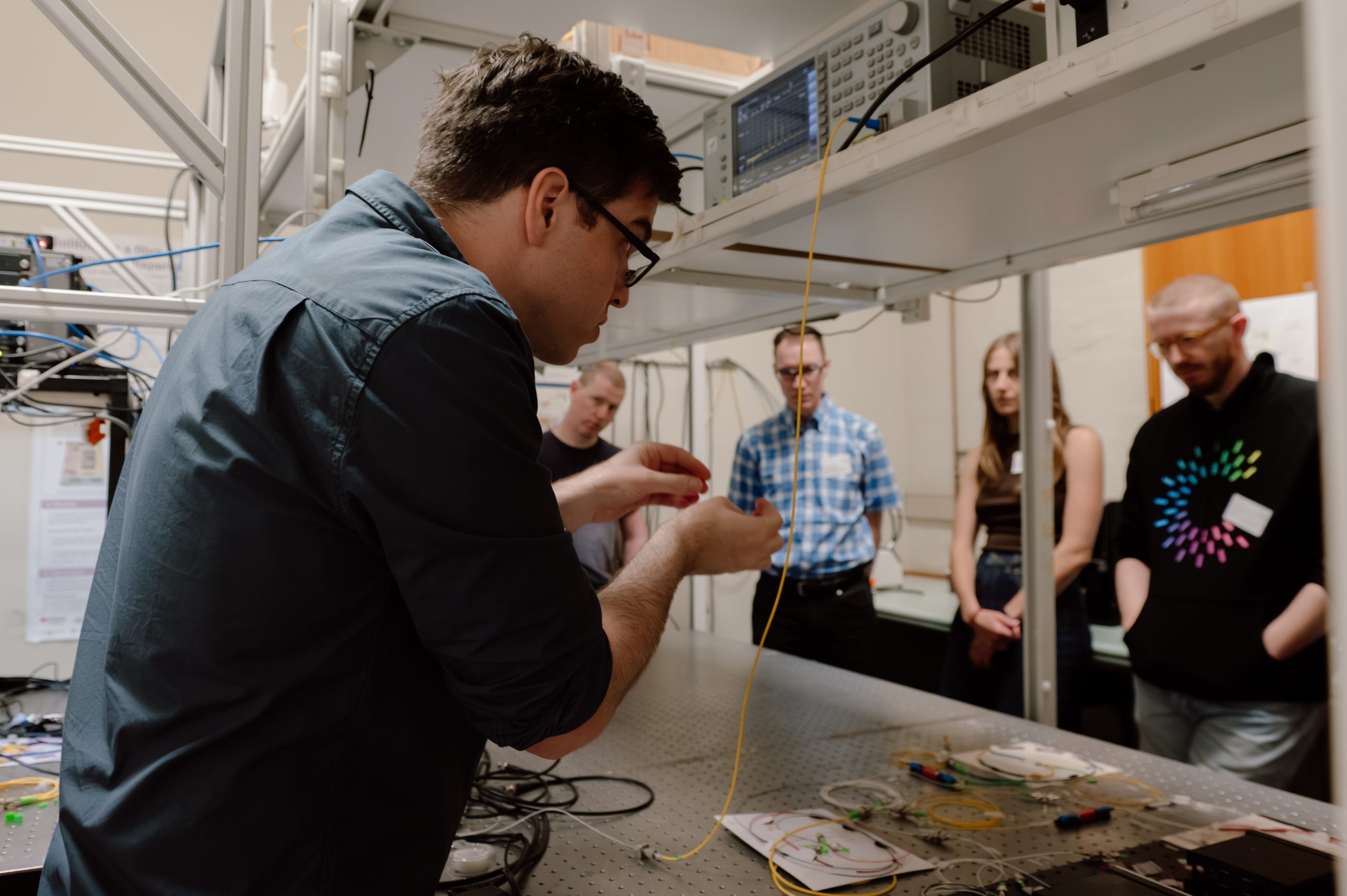
Associate Investigator Dr Antoine Runge describing the setup to other COMBS members at the 2026 University of Sydney laboratory visit.
Our response
To anticipate future design needs, our researchers explored how different ‘light shapes’ emerge from the optical frequency comb.
In a Nature Communications paper, they discovered an unusual ‘spiky’ shape that always requires the same total energy to operate – a feature that may benefit applications that need stable and predictable power consumption.
They also found that this comb shape produces shorter pulses of light, allowing more pulses to fit within the same time window.
In principle, this behaviour could allow more information to be carried in our optical fibres, with potential benefits for high-speed internet speeds.
The results
By discovering new ways light can behave inside an optical frequency comb, our researchers are giving engineers new tools to design microcomb devices for future real-world applications.
Beyond potential technological applications, this work is also attracting interest from mathematicians studying the underlying physics of the constant-energy feature, helping to build interdisciplinary collaborations around our Centre’s research.
The lead author Van Thuy Hoang is also now disseminating his insight at the University of Sydney in a new role at Adelaide University – rapidly sharing knowledge throughout the Centre.
These fundamental discoveries ensure that when new applications emerge that require an optical frequency comb, our researchers will already have a deeper set of tools to make them a reality.
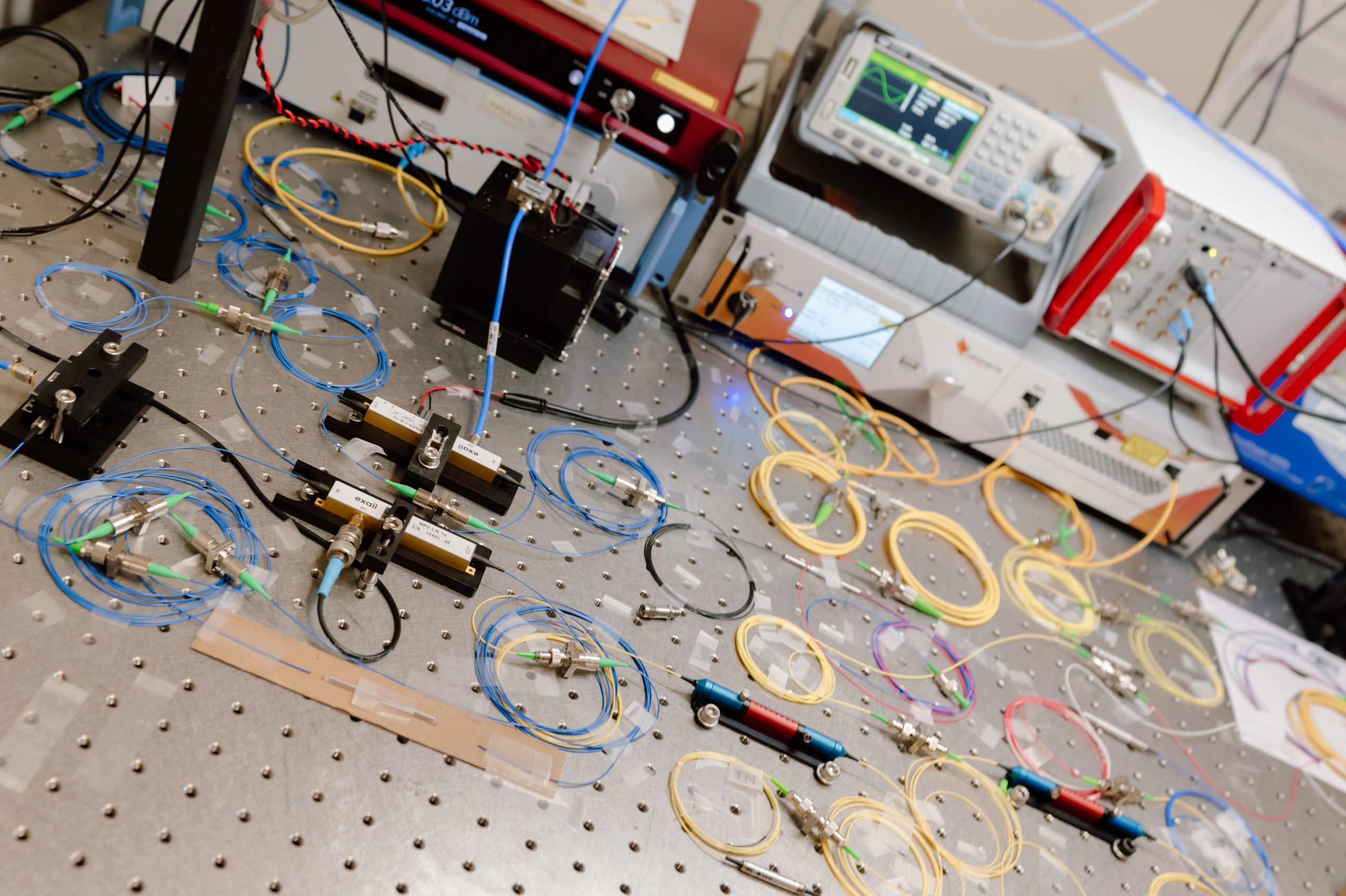
The laboratory setup used to create the unusual 'spiky' light shape with potential energy efficiency benefits and shorter pulses of light.
Team

Dr Van Thuy Hoang
Van Thuy is a member of research staff at The University of Sydney. He works on the Science and Technology theme.

Professor (Carel) Martijn de Sterke
Martijn is a theoretical physicist with interests in nonlinear optics, lasers, and theoretical mechanics.

Dr Antoine Runge
Antoine’s research is currently focused on optical solitons for use in nonlinear photonic applications.

Dr Yunlong (Long) Qiang
Yunlong is a member of research staff at The University of Sydney. He works on the Science and Technology theme.
The team also included researchers outside of COMBS, including:
- Justin Widjaja, PhD student, The University of Sydney
- Maxwell Lui, Undergraduate student, University of Sydney
- Tristam Alexander, Professor in Physics, Institute of Photonics and Optical Science, University of Sydney