The Conversation article: Two subsea cables off Perth suffer ‘concerning’ damage. Lasers could help protect them
This article was written by Bill Corcoran, Allison Kealy, Arnan Mitchell and Luke Broadley for The Conversation. Read the full article here.
Earlier this week, Bevan Slattery, the chief executive of subsea cable company SubCo, announced that two cables had experienced faults over the weekend. He deemed it a “concerning development” because these “submarine cables are the digital lifeblood of our nation”.
Slattery called on federal police to investigate the issue urgently.
The subsea cable damage occurred within the Perth Submarine Cable Protection Zone, an area specifically designed to keep these cables safe. However, this safe zone extends over 100 kilometers offshore with the cables on the seabed, making them difficult to monitor and access.
But there is a way Australia can practically safeguard these cables.
Connecting us to the rest of the world
Australia is connected to the global internet by fewer than two dozen undersea fibre optic cables, which carry more than 95% of our international internet traffic.
Each cable has multiple strands of optical fibre – structured glass about an eighth of a millimetre across – and can carry more than 20 terabits per second. In other words, two of these fibres could carry all of the National Broadband Network’s data.
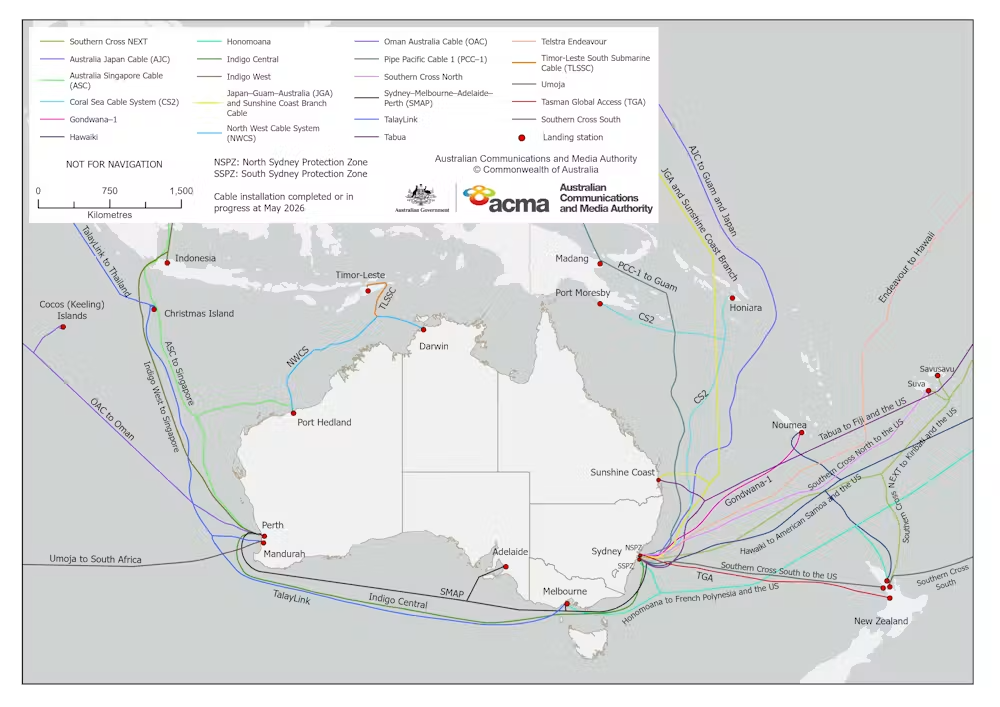
The Indigo West and Indigo Central cables that were affected connect Perth to Sydney, and Perth to Jakarta and Singapore. These are part of a web of fibre optic cables that connect Australia to the world.
Australia’s access to the global internet depends on a surprisingly small number of undersea cables – just 22 are connected or currently being built. Satellites are valuable for connecting remote areas, but they cannot yet carry anything like the enormous amount of data that travels through these cables.
What could have caused the damage?
Slattery called the issues a “shunt fault”. This is where the electrical part of the cable is damaged, degrading performance or stopping the cable from working entirely.
Subsea optical cables are able to span thousands of kilometres due to the use of optical amplifiers which boost the signal every 50 to 100 kilometres.
These optical amplifiers need electrical power to run, and so high-voltage direct current power is transmitted through metal wires alongside the glass optical fibres.
There can be multiple causes of shunt faults that short out this power supply.
There is increasing concern about deliberate interference. But most often these faults are accidental, caused by anchors or trawler nets dragging along the seafloor.
Slattery said we “will not know the root cause” of the fault “until the cable is recovered during repair”.
But how can we more effectively monitor these cables?
Home-grown tech to keep us connected to the world
Distributed acoustic sensing is a laser technology that can sense vibrations travelling across fibre optic cables. It is an evolving technology only recently adopted by fibre optic communications companies for monitoring their infrastructure.
You can think of this technology a bit like shouting “coo-ee”: listening for the echoes can tell you something about what they reflected off. Similarly, distributed acoustic sensing measures light “echoing” off small changes along the length of a fibre.
Crucially, it can sense the environment around the fibre to tell us things about vessel activity, seabed disturbances, and other physical interactions near the cable.
The technology can also be used to map the structure of the soil and rock around the fibre, or to monitor and provide early warning of earthquakes and tsunamis.
Slattery said that if distributed acoustic sensing had been installed on the affected cables, it would have been possible to identify the vessel responsible for the fault almost instantly.
He also said that because the technology is installed on nearby unaffected cables in the same area, “we can confirm no seabed activity around or near” those other cables.
Working towards more resilient national infrastructure
Distributed acoustic sensing can provide both environmental monitoring of the world around us and a way to safeguard key national infrastructure.
Our team’s work has also shown that this evolving technology and high speed data can simultaneously work right next to each other in the same fibre. This is important as telcos have stringent requirements on keeping data flowing through these cables, with heavy penalties for non-compliance.
We think we can help get more distributed acoustic sensing into our fibres in two ways: by demonstrating it can live side-by-side in modern optical communications systems with data, and by leveraging optical microcomb technologies to make the technology smaller, better, and perhaps cheaper.
Our research is showing that the existing fibres that connect Australia to the rest of the world could carry significantly more data than they are currently. They could also reveal new insights about the world around us.
By making this technology affordable and deployable, we will make Australia’s future communications networks not only faster, but safer and more resilient.
Read the full article here.
Authors

Dr William (Bill) Corcoran
Bill is an optical communications researcher focusing on using novel photonic technologies to fix problems in the systems underpinning the backbone of the internet.

Professor Allison Kealy
Allison is a Professor specialising in Geodesy and resilient positioning, navigation, and timing, with the aim of developing more resilient navigation systems that can operate without dependency on satellite signals.

Professor Arnan Mitchell
Distinguished Professor Arnan Mitchell is an expert in integrated photonics who works with academics and industry to create technology solutions with real world impact.

Mr Luke Broadley
Luke is a member of Technical Staff at RMIT University. He works on the Sensing and Measurement and Science and Technology themes.